Shopify Shipping Costs Explained for Beginners
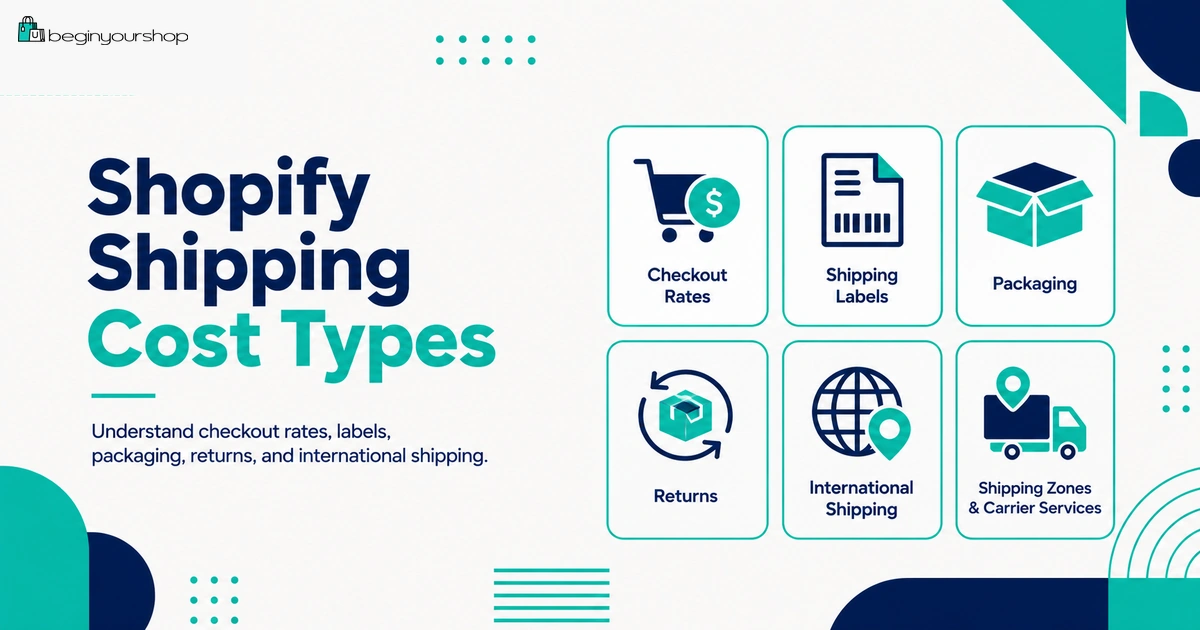
Shopify shipping costs can be confusing because there are two different sides to understand: what customers pay at checkout and what you pay to ship the order. These two amounts are not always the same.
This beginner-friendly article explains Shopify shipping costs, including free shipping, flat rates, carrier-calculated rates, shipping labels, Shopify Shipping, packaging costs, product weights, shipping profiles, return labels, international shipping, duties and taxes, and how to avoid losing money on shipping.
Shipping is one of the most important cost areas in a Shopify store. It affects conversion, profit margin, customer satisfaction, refund risk, and whether your store can operate smoothly after the first orders arrive.
Many beginners think shipping is simple: charge customers a shipping fee, buy a shipping label, and send the package. In reality, Shopify shipping has several moving parts.
You need to decide what customers see at checkout, what you actually pay the carrier, whether you absorb some shipping cost into product prices, whether you offer free shipping, whether rates are flat or calculated, how packaging affects weight and dimensions, how return shipping works, and whether international shipping creates duties, taxes, or delivery surprises.
The most important concept is this:
The shipping rate customers pay at checkout is not automatically the same as the real shipping cost you pay to send the order.
This guide explains Shopify shipping costs from a beginner’s perspective so you can choose a practical shipping strategy without damaging your margins or surprising customers at checkout.
Last checked: September 18, 2026. Shopify shipping rates, carrier-calculated rate availability, label billing, Shopify Shipping carrier support, insurance, return label options, duties and taxes, and plan requirements can change. Always confirm current details in Shopify’s official Help Center and in your Shopify admin before setting shipping rates or buying shipping labels.

Quick Answer
Shopify shipping costs include more than the shipping fee shown to customers at checkout. You need to consider what customers pay, what you pay for shipping labels, packaging materials, carrier rates, product weight and dimensions, shipping zones, returns, international shipping, duties, taxes, insurance, and any shipping apps or third-party carrier accounts. Beginners should usually start with a simple strategy: free shipping threshold, flat rates, or built-in carrier-calculated rates, then adjust after real order data.
Customer shipping rate
The amount a customer sees and pays for shipping at checkout.
Your real shipping cost
The amount you pay for labels, packaging, carrier charges, returns, and handling.
Best beginner rule
Do not offer free or cheap shipping until you know your average real shipping cost.
Shipping Rate vs Real Shipping Cost
The first thing beginners need to understand is the difference between a shipping rate and a shipping cost.
| Term | Meaning | Example |
|---|---|---|
| Shipping rate | What the customer pays at checkout. | You charge $5 shipping on an order. |
| Shipping cost | What you pay to ship the order. | The shipping label costs you $7.80. |
| Shipping loss | When the customer pays less than your real shipping cost. | Customer pays $5, but you pay $7.80. |
| Shipping margin | When the customer pays more than your real shipping cost. | Customer pays $8, but you pay $6.50. |
The goal is not always to make profit on shipping. Many stores intentionally absorb some shipping cost to increase conversion. But you should know when you are absorbing the cost and how much it affects your margin.
Why this matters
- Undercharging shipping can reduce profit on every order.
- Overcharging shipping can increase abandoned checkouts.
- Free shipping can increase conversion, but the cost must be built into product pricing or margin.
- Carrier-calculated rates can protect margin, but customers may see higher shipping costs at checkout.
- Packaging, returns, and handling costs can make real shipping more expensive than the label alone.
Main Shopify Shipping Cost Types
Shopify shipping costs can come from several areas.
| Cost type | What it includes | Beginner note |
|---|---|---|
| Checkout shipping rate | Free shipping, flat rate, price-based rate, weight-based rate, or carrier-calculated rate shown to customers. | This affects conversion and customer expectations. |
| Shipping label cost | The amount you pay to buy a label from a carrier or through Shopify. | This is one of your real fulfillment costs. |
| Packaging | Boxes, mailers, envelopes, tape, labels, inserts, padding, and protective materials. | Often ignored by beginners. |
| Handling | Labor, picking, packing, time, warehouse work, and fulfillment overhead. | Even solo sellers should understand the time cost. |
| Returns | Return labels, replacement shipping, damaged goods, restocking, and refund handling. | Return shipping rules should be clear before launch. |
| International costs | Higher carrier rates, duties, taxes, customs forms, delivery delays, and returns. | International shipping can be much more complex than domestic shipping. |
| Shipping apps | Monthly, usage-based, or label-related app charges. | Useful when needed, but not always necessary at launch. |
Before setting shipping rates, estimate your real shipping cost per order. Even a rough estimate is better than guessing.
Free Shipping
Free shipping is popular because customers like it and it can improve conversion. But shipping is never actually free. Someone pays for it, either you or the customer through product pricing.
A free shipping strategy usually works by absorbing shipping cost into your product margin or increasing product prices enough to cover average shipping.
Common free shipping setups
- Free shipping on all orders
- Free shipping over a minimum order amount
- Free shipping for certain products
- Free shipping for certain customer groups through discount codes
- Free shipping during promotions
Free shipping can work well when:
- Your products have enough margin.
- Your average shipping cost is predictable.
- You can set a free shipping threshold above your average order value.
- You sell lightweight or easy-to-ship products.
- You want to reduce checkout friction.
Free shipping can hurt when:
- Your products are heavy or bulky.
- Your margins are thin.
- You ship to expensive regions without restrictions.
- You set the threshold too low.
- You do not include packaging and return costs in your calculations.
Simple free shipping formula
Minimum free shipping threshold = average order value target + average shipping cost buffer
For example, if customers usually spend around $38 and your average shipping cost is around $7, you might test a free shipping threshold above $50 instead of offering free shipping on every order.
Flat Rate Shipping
Flat rate shipping means you set the shipping price yourself. Shopify lets you charge a fixed amount, offer free shipping, or vary shipping price based on order value or weight.
Common flat rate examples
- $5 domestic shipping
- $10 standard shipping
- $5 shipping for orders over $50
- Free shipping over $75
- $8 shipping for orders under 2 lb
- $15 shipping for orders between 2 lb and 5 lb
Flat rate shipping works well when:
- Your products have similar weights and sizes.
- Your shipping regions are predictable.
- You want checkout to feel simple.
- You can estimate average shipping cost accurately.
- You want customers to understand shipping before checkout.
Flat rate shipping can be risky when:
- Your products vary widely in size or weight.
- You ship to distant or expensive regions.
- Some orders cost much more to ship than others.
- You do not review real shipping label costs after launch.
Flat rate shipping is simple for customers, but you need to review whether the rate covers your average shipping cost.
Carrier-Calculated Shipping
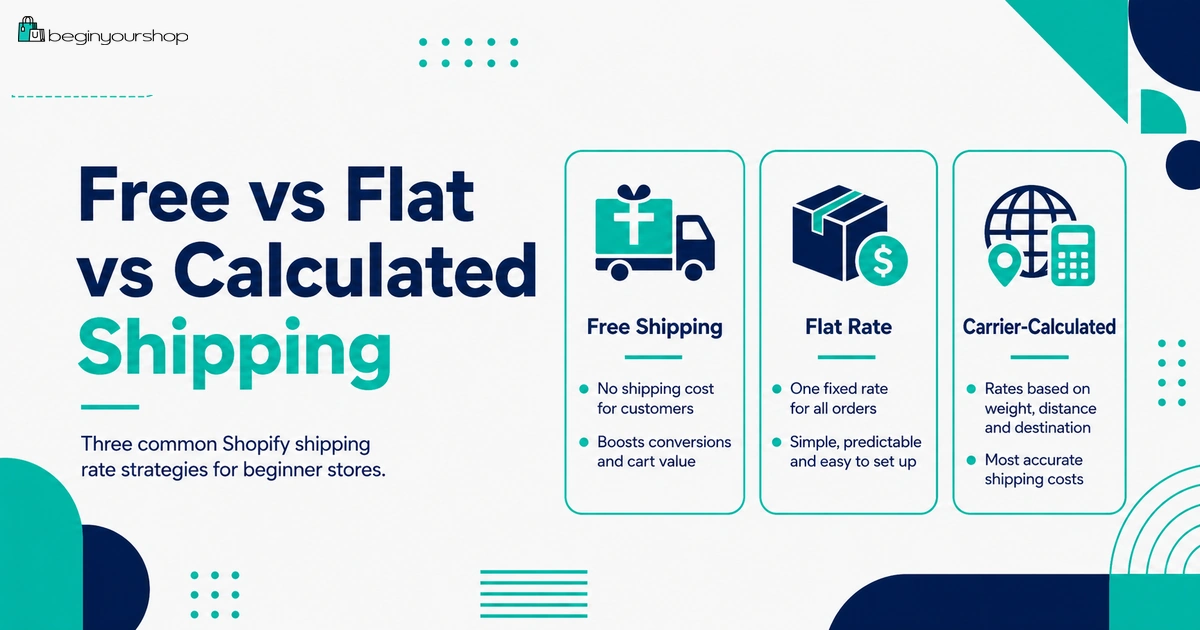
Carrier-calculated shipping displays rates from shipping carriers at checkout. The carrier calculates the shipping cost based on details such as origin, destination, shipment weight, shipment value, package dimensions, dimensional weight, and delivery speed.
This can help you charge customers closer to the real shipping cost, especially if products vary in size or destination.
Carrier-calculated shipping works well when:
- Shipping costs vary significantly by destination.
- Products have different weights and dimensions.
- You want customers to choose specific carrier services.
- You want to protect profit margin.
- You ship internationally or to wide geographic zones.
Carrier-calculated shipping can hurt conversion when:
- Customers do not see shipping cost until checkout.
- The calculated rate feels unexpectedly high.
- You sell low-price items where shipping looks large compared with product price.
- You do not show delivery expectations clearly.
Important setup details
- Enter accurate product weights.
- Set correct package dimensions.
- Review your default package settings.
- Test checkout to see what customers see.
- Consider adding handling fees if packaging or fulfillment costs need to be covered.
- Consider discounting calculated rates if rates are too high for conversion.
Shopify’s built-in carrier integrations are available in certain countries and scenarios. If you want to connect your own carrier accounts, then third-party carrier-calculated shipping may require specific Shopify plans or an additional monthly fee on your Shopify account.
Shopify Shipping Labels
Shopify Shipping lets eligible merchants buy, print, and manage shipping labels from supported carriers inside Shopify.
Buying labels through Shopify can be useful because the order, label, tracking, and fulfillment information are connected in one workflow.
Shopify Shipping labels can help with:
- Buying labels individually
- Buying labels in bulk
- Printing labels
- Reprinting labels
- Tracking deliveries
- Scheduling carrier pickups where supported
- Buying return labels in supported situations
- Adding shipping insurance where supported
- Submitting claims for lost or damaged shipments where supported
Shopify Shipping is useful when:
- Your fulfillment location is eligible.
- You want label buying inside Shopify admin.
- You want tracking to connect to orders.
- You do not want to manage labels completely outside Shopify.
- Shopify-supported carriers cover your shipping needs.
When you may need other tools
You may need a third-party shipping app, fulfillment service, or carrier account if:
- Your country or carrier is not supported by Shopify Shipping.
- You need specialized shipping services.
- You use a fulfillment warehouse or 3PL.
- You need advanced shipping rules.
- You need carrier account rates that require third-party carrier-calculated shipping.
- You sell through multiple channels and need a separate shipping platform.
Billing for Shipping Labels
Shipping labels are a real cost to the merchant. Shopify says that after you buy a shipping label, the cost and taxes are billed through your Shopify account.
This means the customer might pay shipping at checkout, but you still buy and pay for the shipping label as part of your fulfillment workflow.
Billing details to understand
- Shipping label charges can appear on your Shopify bill.
- Taxes might be added depending on your location and the label.
- If your total charges reach a billing threshold, Shopify can issue an invoice immediately instead of waiting for the regular billing date.
- If you void an unused label, the cost can be credited to your account.
- If the package has already shipped, you generally need to work with the carrier for help.
Label cost vs checkout rate
Do not assume the label cost will always match the checkout shipping rate. Differences can happen because of packaging, weight, dimensions, service selected, carrier adjustments, customer shipping rate settings, or manual changes.
After your first orders, compare:
- Customer shipping paid
- Shipping label cost
- Packaging cost
- Return risk
- Handling time
- Actual profit after shipping
Weights, Dimensions, and Packages
Product weight, package dimensions, and dimensional weight can strongly affect shipping costs.
Shopify states that accurate product weights are needed to ensure accurate carrier-calculated rates at checkout, and that default package dimensions are also used by carriers to calculate shipping rates.
Weight and dimension checklist
- Enter accurate product weight.
- Include packaging weight when estimating shipping.
- Measure package length, width, and height.
- Use realistic package sizes.
- Understand dimensional weight for bulky lightweight items.
- Test different package types if costs vary.
- Review actual label costs after shipping real orders.
Common beginner problem
A beginner enters product weight but forgets the box, mailer, protective padding, inserts, or dimensional weight. The checkout rate then looks accurate in theory but the actual label cost is higher.
Build your shipping calculations around the packed order, not only the product itself.
Shipping Zones and Profiles
Shipping zones and shipping profiles control where you ship and which rates apply.
Shipping zones
A shipping zone is a group of countries or regions where you offer shipping. For example:
- Domestic shipping zone
- United States shipping zone
- Canada shipping zone
- European Union shipping zone
- Rest of world shipping zone
Shipping profiles
Shipping profiles let you create different shipping rules for different groups of products. This is useful when some products require different rates or fulfillment methods.
Use custom shipping profiles when:
- Some products are heavy or bulky.
- Some products ship from a different location.
- Some products need free shipping.
- Some products cannot ship internationally.
- Some products use a fulfillment partner.
- Digital products do not require shipping.
Keep shipping profiles simple at the beginning. Too many profiles can create checkout confusion and rate conflicts.
Packaging and Handling Costs
Packaging is part of shipping cost. Beginners often count only carrier label cost and forget the cost of materials and time.
Packaging costs can include:
- Boxes
- Padded mailers
- Poly mailers
- Envelopes
- Tape
- Thermal labels
- Printer or label printer costs
- Protective padding
- Tissue paper
- Product inserts
- Thank-you cards
- Branded packaging
- Warehouse supplies
Handling costs can include:
- Picking products
- Packing orders
- Printing labels
- Dropping off packages
- Scheduling pickups
- Customer support about delivery
- Return handling
You can add a handling fee to carrier-calculated rates in Shopify to help account for packaging and handling costs. Use this carefully because higher shipping rates can affect checkout conversion.
Return Shipping Costs
Return shipping can be a significant hidden cost. Before launching, decide who pays for return shipping and when you provide prepaid return labels.
Common return shipping models
- Customer pays return shipping.
- Store pays return shipping for defective or incorrect items.
- Store offers free returns for all eligible products.
- Return shipping cost is deducted from refund.
- Exchanges get different shipping treatment than refunds.
Return shipping policy should explain:
- Which products can be returned
- How many days customers have
- Who pays return shipping
- Whether original shipping is refunded
- Whether return labels are provided
- How exchanges are handled
- What happens with damaged or wrong items
If you offer free returns, include the expected return cost in product pricing or margin planning.
International Shipping Costs
International shipping can increase complexity quickly. Carrier rates are usually higher, delivery times can vary, customs documentation may be required, and duties and taxes can create customer surprises.
International costs can include:
- Higher shipping label costs
- Customs forms
- Duties
- Import taxes
- Currency effects
- Longer delivery times
- More customer support
- Higher return costs
- Lost or delayed package claims
Before shipping internationally, decide:
- Which countries you will ship to
- Which products can ship internationally
- Which carrier services you will offer
- Whether customers pay duties and taxes on delivery
- Whether duties and taxes are collected upfront where supported
- Whether international returns are accepted
- How delivery timelines are communicated
Many beginners should start with one primary domestic market, then expand internationally after understanding real order volume and shipping performance.
Apps and Third-Party Carrier Accounts
Shopify’s built-in shipping tools are enough for many new stores, but some businesses need shipping apps or connected carrier accounts.
You may need a shipping app if:
- You need complex shipping rules.
- You need real-time rates from carriers not supported in your setup.
- You ship from multiple warehouses.
- You use a 3PL or fulfillment partner.
- You need advanced packing logic.
- You need label automation.
- You need multi-channel shipping management.
Cost warnings for shipping apps
- Some apps charge monthly subscriptions.
- Some apps charge per label or usage.
- Some apps require third-party carrier-calculated shipping to be active.
- Some apps bill outside Shopify.
- Some apps require technical setup and testing.
Do not add a shipping app just because shipping feels complicated. First check whether Shopify’s built-in shipping rates, profiles, and label tools can solve the problem.
Beginner Shipping Cost Strategy
For a beginner store, shipping strategy should be simple enough to manage but accurate enough to protect your margin.
Step 1: Estimate real shipping cost
Calculate:
- Average product weight
- Package weight
- Package dimensions
- Carrier label estimate
- Packaging materials
- Return risk
- Handling time
Step 2: Choose a checkout rate strategy
Pick one:
- Free shipping threshold: Good for increasing average order value if margin supports it.
- Flat rate: Good for predictable products and simple checkout expectations.
- Carrier-calculated rates: Good for variable weights, destinations, or shipping services.
- Mixed strategy: For example, flat domestic rate plus calculated international rates.
Step 3: Test checkout
Before launch, test:
- Domestic address
- Expensive region address
- Low order value
- High order value
- Multiple-product cart
- Heavy-product cart
- Free shipping threshold
- Discount code behavior
- International address if offered
Step 4: Review real orders
After real orders, compare customer-paid shipping with actual label and packaging cost.
| Metric | Why it matters |
|---|---|
| Customer shipping paid | Shows what checkout collected. |
| Label cost | Shows carrier shipping cost. |
| Packaging cost | Shows extra fulfillment cost. |
| Shipping profit or loss | Shows whether shipping is helping or hurting margin. |
| Abandoned checkouts | Can show whether shipping costs are discouraging customers. |
| Return rate | Shows whether return shipping needs to be included in pricing. |
Shopify Shipping Cost Checklist
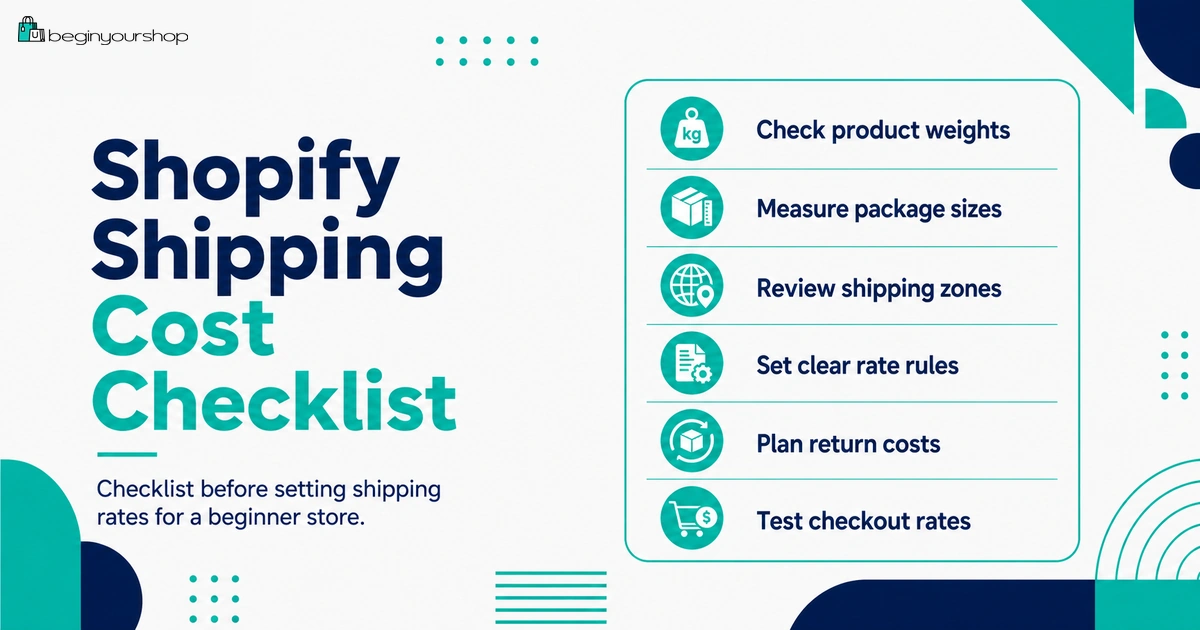
Use this checklist before launching shipping on your Shopify store.
| Question | Ready? |
|---|---|
| I know what customers will pay at checkout for shipping. | Yes / No |
| I estimated my real label cost for common orders. | Yes / No |
| I included packaging materials in my cost estimate. | Yes / No |
| I entered accurate product weights. | Yes / No |
| I reviewed package dimensions and default package settings. | Yes / No |
| I created shipping zones for the regions I actually ship to. | Yes / No |
| I know whether I use free shipping, flat rates, carrier-calculated rates, or a mixed strategy. | Yes / No |
| I tested checkout with different addresses and cart values. | Yes / No |
| I wrote a clear shipping and delivery policy. | Yes / No |
| I wrote a clear return shipping policy. | Yes / No |
Common Shopify Shipping Cost Mistakes
Mistake 1: Thinking free shipping is free
Free shipping is a pricing strategy. You still pay the carrier, packaging, and handling costs.
Mistake 2: Forgetting packaging costs
Boxes, mailers, labels, tape, inserts, and padding can reduce margin if they are not included in your cost estimate.
Mistake 3: Entering inaccurate product weights
Wrong product weights can create wrong checkout rates and wrong label estimates.
Mistake 4: Ignoring package dimensions
Dimensional weight can make large lightweight products more expensive to ship than expected.
Mistake 5: Using one flat rate for very different products
A single flat rate can work for similar products, but it can create losses if some items are much heavier or bulkier.
Mistake 6: Shipping internationally too early
International shipping adds duties, taxes, returns, customs, delivery time, and support complexity.
Mistake 7: Not testing checkout
Test multiple addresses, cart values, product combinations, and shipping options before sending real traffic.
Mistake 8: Not reviewing real shipping performance
After launch, compare customer-paid shipping with real label and packaging costs. Adjust rates if needed.
FAQ
What are Shopify shipping costs?
Shopify shipping costs can include what customers pay at checkout, shipping label costs, packaging, handling, return shipping, international shipping, duties and taxes, insurance, and shipping app costs.
What is the difference between shipping rates and shipping labels?
Shipping rates are what customers see and pay at checkout. Shipping labels are what you buy to ship the order with a carrier. These amounts are not always the same.
Can I offer free shipping on Shopify?
Yes. You can offer free shipping, including free shipping over a minimum order amount. But you still need to include the cost in product pricing, margin, or marketing budget.
Can I set flat rate shipping on Shopify?
Yes. Shopify lets you set flat rates, including fixed rates, order amount-based rates, and weight-based rates.
What is carrier-calculated shipping?
Carrier-calculated shipping shows shipping rates from carriers at checkout based on order details such as origin, destination, weight, dimensions, value, and delivery speed.
Do I need accurate product weights?
Yes, especially if you use carrier-calculated rates. Accurate product weights and package dimensions help shipping rates reflect real shipping costs.
Does Shopify charge for shipping labels?
When you buy a shipping label through Shopify, the label cost and taxes are billed through your Shopify account.
Can I void a Shopify shipping label?
If a shipping label has not been used, you can void it in supported situations and the label cost can be credited to your account. If the package has shipped, you generally need to contact the carrier.
Should beginners use free shipping or calculated shipping?
It depends. Free shipping can improve conversion if margin supports it. Calculated shipping can protect margin when costs vary. Flat rates can be easiest when products and destinations are predictable.
Do I need a shipping app?
Not always. Many beginners can start with Shopify’s built-in shipping settings, shipping profiles, and label tools. Use a shipping app only if you need features Shopify does not already provide for your setup.
Final Thoughts
Shopify shipping costs are not only about the amount a customer pays at checkout. They include label costs, carrier rates, packaging, handling, returns, international complexity, and possible app costs.
For beginners, the safest approach is to keep shipping simple. Start with a free shipping threshold, a flat rate, carrier-calculated rates, or a simple mixed strategy. Then test checkout and review real order data after launch.
Do not guess blindly. Estimate rea