Shopify vs Etsy
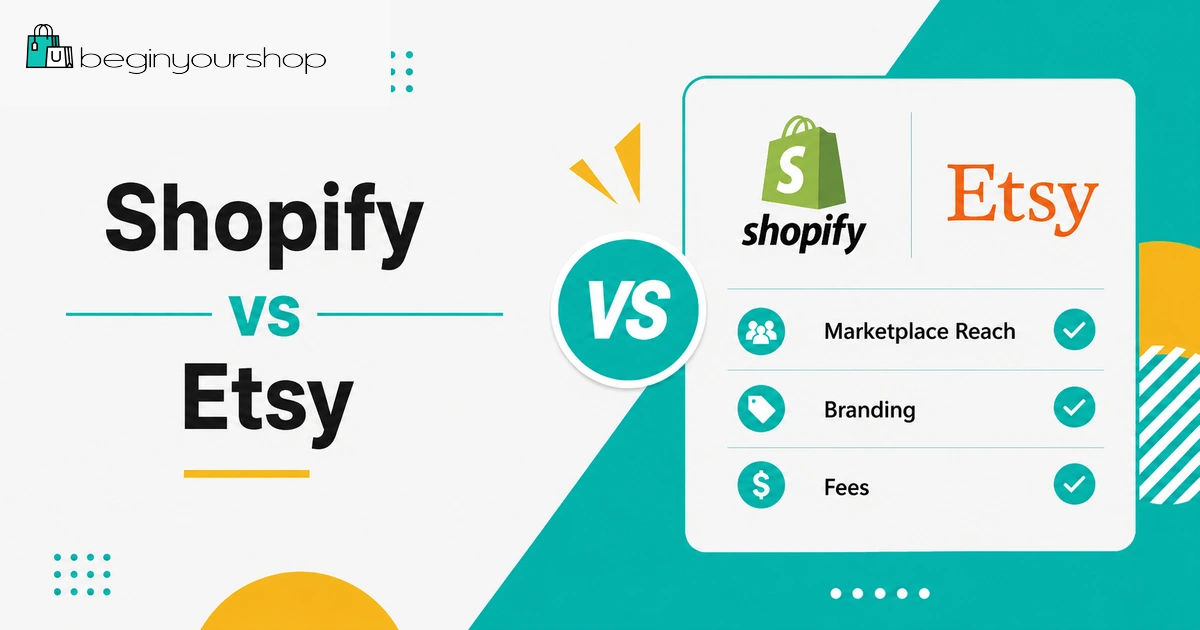
Shopify and Etsy can both help you sell products online, but they are not the same type of platform. Shopify is an ecommerce platform for building your own online store under your own brand. Etsy is a marketplace where buyers already search for handmade, vintage, creative, and unique products.
This comparison explains the key differences between Shopify and Etsy, including traffic, brand control, fees, product fit, payments, marketing, scalability, customer ownership, and which option is better for beginners.
Shopify and Etsy are often compared by new sellers, but they solve different problems.
Shopify helps you build your own ecommerce website. You control the storefront, domain, branding, product pages, customer experience, marketing channels, and long-term brand strategy. The trade-off is that you need to bring your own traffic through SEO, social media, ads, email, content, referrals, partnerships, or other marketing channels.
Etsy gives you access to a marketplace where buyers are already searching for handmade items, vintage products, craft supplies, personalized goods, creative products, and giftable items. The trade-off is that you compete inside Etsy’s marketplace, follow Etsy’s rules, pay marketplace fees, and have less control over the full customer relationship.
This guide compares Shopify vs Etsy from a beginner’s perspective so you can decide whether you should build your own store, sell on a marketplace, or use both.
Last checked: May 9, 2026. Platform features, pricing, fees, plan names, marketplace rules, and seller policies can change. Always confirm current details on Shopify and Etsy official websites before choosing a platform.
Quick Verdict
Choose Shopify if...
- You want to build your own branded online store.
- You want more control over design, customer experience, and marketing.
- You plan to grow beyond marketplace selling.
- You want to own more of the customer relationship.
- You are willing to work on traffic generation outside a marketplace.
Choose Etsy if...
- You sell handmade, vintage, creative, personalized, or giftable products.
- You want access to marketplace search and existing buyer intent.
- You want a simpler way to test product demand.
- You do not want to build a full website right away.
- You are comfortable following marketplace rules and fee structures.
For most beginners who want to test handmade, creative, or personalized products, Etsy can be easier for early discovery. For beginners who want to build a long-term ecommerce brand they control, Shopify is usually the better foundation.
Shopify vs Etsy: Best For
The Shopify vs Etsy decision is not only about cost. It is about whether you want to sell inside an existing marketplace or build your own store and traffic system.
| Situation | Better choice | Why |
|---|---|---|
| Testing handmade or personalized products | Etsy | Etsy already attracts buyers looking for creative, handmade, vintage, and giftable items. |
| Building a long-term ecommerce brand | Shopify | Shopify gives you more control over branding, domain, customer experience, and marketing. |
| Lowest upfront website setup | Etsy | You can list products without building a full store website first, though selling fees still apply. |
| Full store design control | Shopify | You can customize your own storefront, navigation, landing pages, product pages, and brand experience. |
| Marketplace search exposure | Etsy | Etsy shoppers can discover your listings through Etsy search and marketplace browsing. |
| Scaling product catalog and marketing funnels | Shopify | Shopify is stronger for brand growth, apps, email capture, analytics, and multi-channel selling. |
| Creative side hustle | Etsy | Etsy can be a practical starting point for hobby sellers and small creative shops. |
Shopify vs Etsy Comparison Table
| Category | Shopify | Etsy |
|---|---|---|
| Platform type | Ecommerce website platform | Online marketplace |
| Primary purpose | Build and manage your own online store | List products inside Etsy’s marketplace |
| Best for | Brands, product stores, growing ecommerce businesses | Handmade, vintage, craft supply, personalized, and creative sellers |
| Traffic | You bring your own traffic | Marketplace search and existing buyer intent can help with discovery |
| Brand control | High | Limited by marketplace structure |
| Fees | Monthly plan plus payment processing and possible third-party transaction fees | Listing fee, transaction fee, payment processing, possible ads, and other marketplace fees |
| Customer relationship | More direct customer ownership and email marketing potential | Customer relationship is inside Etsy’s marketplace rules |
| Design flexibility | More storefront and landing page control | More limited shop and listing page customization |
| Scalability | Better for building a standalone brand | Good for marketplace selling but less control long term |
| Beginner recommendation | Choose if you want a store you control | Choose if you want marketplace discovery and creative-product fit |
What Is Shopify?
Shopify is a hosted ecommerce platform that lets you build your own online store. You can add products, customize your theme, set up payments, manage orders, configure shipping, connect a domain, install apps, and grow your store under your own brand.
Shopify is not a marketplace in the same way Etsy is. When you create a Shopify store, shoppers do not automatically find you through a built-in Shopify marketplace search. You need to build traffic through marketing channels such as SEO, social media, paid ads, content marketing, email, influencer partnerships, referrals, or offline promotion.
The benefit is control. You can build your own brand, customer list, product pages, offers, content, and store experience. Shopify is usually the better choice if your goal is to create a business that is not dependent on a single marketplace.
What Is Etsy?
Etsy is an online marketplace focused on handmade products, vintage items, craft supplies, personalized goods, and creative products. Sellers open Etsy shops and list products inside Etsy’s marketplace, where buyers can search, browse, and purchase.
Etsy can be attractive for beginners because it gives sellers access to an existing marketplace. You do not need to build a full website or attract all traffic from scratch before listing your first products.
The trade-off is control. Your shop exists inside Etsy’s marketplace structure. You compete beside other Etsy sellers, follow Etsy’s policies, pay marketplace fees, and depend partly on Etsy search, rules, and buyer behavior.
Traffic and Discovery
Traffic is one of the biggest differences between Shopify and Etsy.
Shopify traffic
With Shopify, you are responsible for getting visitors to your store. This is harder at the beginning, but it also gives you more control over your long-term marketing engine.
Common Shopify traffic channels include:
- Google SEO
- Blog content
- Social media
- Paid ads
- Email marketing
- Influencer partnerships
- Affiliate marketing
- Organic short-form video
- Referral programs
Shopify is stronger when you are willing to build a traffic strategy and brand audience over time.
Etsy traffic
Etsy has marketplace traffic. Buyers already visit Etsy to search for gifts, handmade goods, personalized products, craft supplies, vintage items, and creative products.
This can make Etsy easier for early product testing, especially if your products match Etsy buyer intent. However, marketplace traffic is not guaranteed. You still need good listing titles, photos, pricing, reviews, shipping, tags, and competitive positioning.
Beginner takeaway: Etsy can help with discovery. Shopify gives more control, but you must build traffic yourself.
Pricing and Fees
Shopify and Etsy have very different cost structures.
Shopify pricing model
Shopify uses paid ecommerce plans. As of the latest checked Shopify pricing page, Shopify lists plans such as Basic, Grow, Advanced, and Plus. Shopify may also offer a free trial or promotional introductory pricing for eligible users.
Shopify costs may include:
- Monthly or yearly Shopify plan
- Payment processing fees
- Third-party transaction fees if using third-party payment providers
- Paid apps
- Premium themes
- Domain name
- POS tools if selling in person
- Marketing, fulfillment, shipping, and product costs
Shopify has a more predictable platform cost, but you need to budget for traffic generation and store-building tools.
Etsy fee model
Etsy does not work like a monthly ecommerce website subscription for the basic marketplace shop. Instead, Etsy charges marketplace-related fees around listings, sales, payments, ads, and optional tools.
Common Etsy fees may include:
- Listing fee: Etsy charges a listing fee for each item listed on Etsy.
- Transaction fee: Etsy charges a percentage transaction fee when you make a sale through Etsy.
- Payment processing fee: Etsy Payments charges processing fees that vary by country.
- Offsite Ads fee: Etsy may charge an advertising fee on attributed orders from offsite ads.
- Regulatory operating fee: Etsy charges this fee in certain countries.
- Currency conversion fee: This may apply when funds are converted to your payment account currency.
- Pattern fee: Etsy’s Pattern website tool is optional and has a separate subscription after a trial.
As of Etsy’s official Fees & Payments Policy, Etsy lists a $0.20 USD listing fee, a 6.5% transaction fee on the listing price plus shipping and gift wrapping, and offsite ads fees of 15% or 12% depending on sales threshold and participation rules. Etsy Payments processing fees vary by country.
Cost comparison
| Cost area | Shopify | Etsy |
|---|---|---|
| Core platform cost | Monthly or yearly subscription plan | No standard monthly marketplace subscription for a basic Etsy shop, but listing and selling fees apply |
| Listing products | No per-product listing fee from Shopify | Listing fee applies to Etsy marketplace listings |
| Sales fees | Payment processing fees; third-party transaction fees may apply | Transaction fee, payment processing fee, and possible ad-related fees |
| Traffic cost | You often need SEO, content, social, ads, or other marketing | Marketplace discovery can help, but ads and competition may still affect cost |
| Best cost fit | Brand-building sellers who want more control | Creative sellers testing product demand inside a marketplace |
Brand Control and Store Ownership
Shopify gives you much more control over your brand experience.
Shopify brand control
With Shopify, you can use your own domain, customize your storefront, design landing pages, build an email list, create content, optimize product pages, control navigation, and create a customer experience around your brand.
You are still using Shopify’s platform, but the store feels like your own website rather than a shop inside someone else’s marketplace.
Etsy brand control
With Etsy, your shop exists inside Etsy’s marketplace. You can customize your shop name, banner, logo, listing photos, product descriptions, policies, and brand tone, but the overall marketplace experience belongs to Etsy.
Buyers may remember they bought from Etsy more than they remember your individual shop. This can make long-term brand building harder.
Product Fit
Etsy and Shopify can both sell many types of products, but Etsy has a much narrower marketplace identity.
Products that fit Etsy well
Etsy is usually best for:
- Handmade products
- Vintage items
- Craft supplies
- Personalized gifts
- Wedding products
- Printable and digital creative products
- Art, jewelry, decor, accessories, and creative goods
If your product matches what Etsy shoppers already expect, Etsy can be a strong discovery channel.
Products that fit Shopify well
Shopify can support a broader range of ecommerce models, including:
- Branded physical products
- Dropshipping
- Print-on-demand
- Beauty and skincare
- Fashion and accessories
- Home goods
- Digital products
- Subscriptions
- B2B and wholesale workflows on higher-level setups
Shopify is better when you want the product and brand to stand on their own, outside of marketplace expectations.
Payments and Checkout
Both platforms let customers pay online, but the checkout experience is controlled differently.
Shopify checkout
Shopify includes a hosted checkout system. Shopify Payments is available in supported countries and regions, and third-party payment providers may also be available. Payment fees depend on plan, payment method, country, and provider.
Shopify checkout is part of your own online store experience, even though it runs on Shopify’s platform.
Etsy checkout
Etsy checkout is marketplace checkout. Buyers purchase through Etsy’s system. Etsy Payments is used by eligible shops to accept certain payment methods, and payment processing fees vary by country.
The benefit is marketplace trust and familiarity. The limitation is that the checkout experience belongs to Etsy, not your independent brand.
Marketing and Customer Relationships
Marketing is where Shopify and Etsy feel very different.
Shopify marketing
With Shopify, you can build a more direct marketing system:
- Email capture
- SMS marketing if legally compliant
- Retargeting ads
- Content marketing
- SEO landing pages
- Blog content
- Customer segmentation
- Affiliate or referral programs
- Brand storytelling
You are responsible for traffic, but you can also build long-term assets that are not tied only to marketplace search.
Etsy marketing
On Etsy, marketing is often focused on marketplace visibility. You optimize listings for Etsy search, improve product photos, gather reviews, manage shipping expectations, test pricing, use tags, and potentially use Etsy Ads or Offsite Ads.
Etsy can help you reach buyers faster, but customer relationship tools are more limited than building your own Shopify store and email list.
Scalability
Both Shopify and Etsy can support growing sellers, but they scale differently.
Shopify scalability
Shopify is usually stronger for long-term ecommerce scaling. You can expand product lines, build landing pages, add apps, improve email marketing, connect sales channels, create bundles, improve analytics, launch ad campaigns, and optimize conversion.
If your goal is to build a brand that can grow beyond one marketplace, Shopify is usually the better foundation.
Etsy scalability
Etsy can scale for successful marketplace sellers, but growth is tied to marketplace rules, competition, ranking, fees, reviews, buyer expectations, and policy changes.
Many sellers use Etsy as a discovery channel but eventually build their own Shopify store to gain more control over branding, customer data, repeat purchases, and marketing.
Can You Use Both Shopify and Etsy?
Yes. For many sellers, Shopify vs Etsy does not have to be an either-or decision.
A common strategy is:
- Use Etsy to test product demand and reach marketplace buyers.
- Use Shopify to build a branded store and long-term customer relationship.
- Use content, email, packaging inserts, and social media to grow brand recognition.
- Keep Etsy as one sales channel while gradually building independent traffic.
However, you should be careful about Etsy’s rules. Etsy restricts off-platform transactions for sales initiated on Etsy. Do not use Etsy to avoid marketplace fees or move Etsy buyers off the platform in ways that violate Etsy policies.
Which Should You Choose?
Choose Shopify if you want:
- Your own branded ecommerce website
- More control over design and customer experience
- Better tools for email marketing and customer retention
- A broader ecommerce app ecosystem
- A stronger long-term brand foundation
- More independence from marketplace search and policies
Choose Etsy if you want:
- Marketplace discovery
- A simpler way to list creative products
- Access to buyers searching for handmade, vintage, or personalized goods
- A practical way to test product demand
- Less need to build a full ecommerce website immediately
- A marketplace channel for a creative side business
For most beginners selling creative or handmade products, Etsy can be a useful starting point. For most beginners who want to build a long-term ecommerce brand, Shopify is the stronger foundation.
Shopify vs Etsy FAQ
Is Shopify better than Etsy?
Shopify is better if you want your own branded store and more control. Etsy is better if you want marketplace discovery for creative, handmade, vintage, or personalized products. The best choice depends on whether you value traffic or control more.
Is Etsy cheaper than Shopify?
Etsy may have lower upfront website costs because you do not need a monthly ecommerce website plan for a basic Etsy shop. However, Etsy charges listing fees, transaction fees, payment processing fees, and possible advertising or other fees. Shopify has a monthly plan but can be more predictable for building your own store.
Does Etsy charge a listing fee?
Yes. Etsy’s official Fees & Payments Policy lists a $0.20 USD listing fee for items listed on Etsy.com or Etsy’s mobile apps. Listings also expire after four months unless renewed.
Does Etsy charge transaction fees?
Yes. Etsy’s official policy lists a 6.5% transaction fee on the listing price plus shipping and gift wrapping when you make a sale through Etsy.com.
Does Shopify have marketplace traffic like Etsy?
No. Shopify does not work like Etsy marketplace search. With Shopify, you build your own store and bring traffic through marketing channels such as SEO, social media, ads, content, email, and partnerships.
Can I sell handmade products on Shopify?
Yes. Shopify can be used to sell handmade products, but you need to bring your own traffic. Etsy may help with marketplace discovery, while Shopify gives more brand control.
Can I use Shopify and Etsy together?
Yes. Many sellers use Etsy for marketplace discovery and Shopify for their own branded store. If you use both, make sure you follow Etsy’s rules about off-platform transactions and customer communication.
Is Shopify good for Etsy sellers?
Yes, especially for Etsy sellers who want more brand control, email marketing, repeat customers, landing pages, and a store that is not fully dependent on Etsy search.
Should I start with Etsy or Shopify?
If you are testing handmade or personalized products and want marketplace discovery, Etsy can be a good starting point. If you are serious about building an independent brand, Shopify may be better from the beginning.
What is Etsy Pattern?
Pattern is Etsy’s website tool that lets Etsy sellers create a separate website for their brand in addition to their Etsy shop. It has a free trial and a monthly fee after the trial. Pattern is not the same as building a full Shopify store, but it can give Etsy sellers an additional branded channel.
Final Thoughts
Shopify vs Etsy is not just a platform comparison. It is a choice between building your own ecommerce store and selling inside an existing marketplace.
Etsy is useful for marketplace discovery, creative products, handmade items, vintage goods, and product testing. Shopify is stronger for building a long-term brand, controlling the customer experience, and growing beyond marketplace limitations.
If you are just testing a creative product idea, Etsy can be a practical place to start. If you want to build a brand you control, Shopify is usually the better long-term foundation.
The smartest path for many sellers is to use Etsy for discovery and Shopify for ownership. Just make sure you understand the fees, rules, and responsibilities of each platform before you commit.
Next recommended comparison: Shopify vs Squarespace