Shopify Domain Costs Explained for Beginners
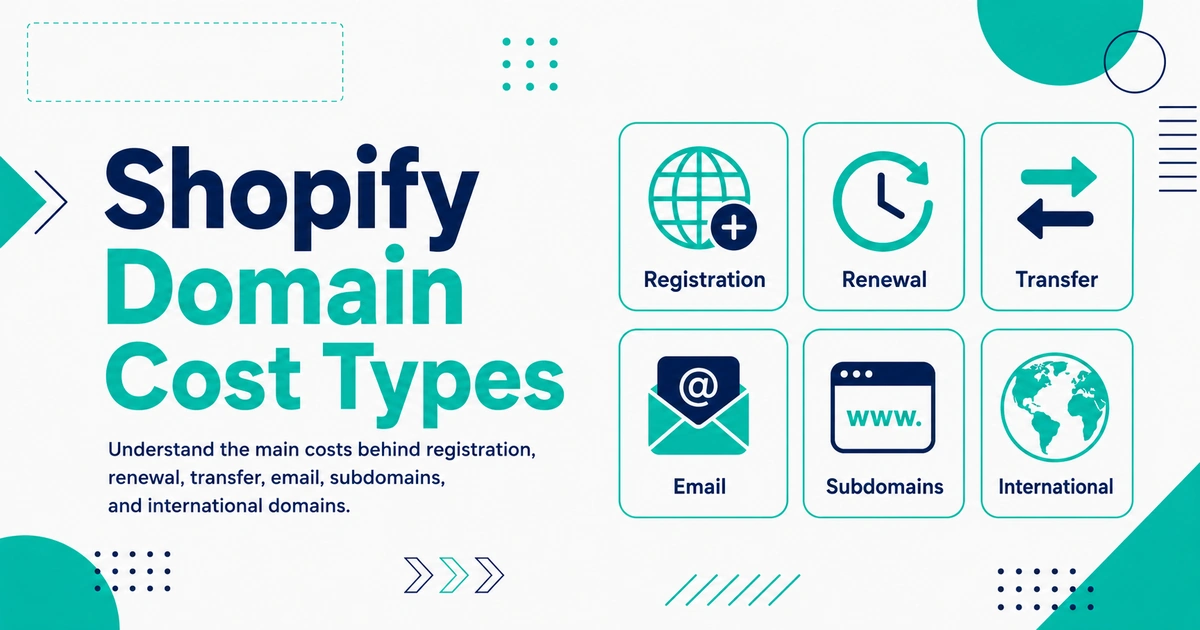
Shopify domain costs are usually separate from your Shopify plan, theme, apps, and payment fees. You can buy a domain through Shopify, connect a domain from a third-party provider, or transfer a domain to Shopify, and each option affects where you manage billing, renewals, DNS settings, email, and support.
This beginner-friendly article explains Shopify domain costs, including buying a domain through Shopify, connecting a third-party domain, transferring a domain, annual renewal fees, email hosting costs, subdomains, international domains, refunds, auto-renewal, and what to check before choosing your store domain.
A custom domain is one of the first branding decisions many Shopify beginners make. Instead of using a default myshopify.com address, a custom domain lets customers visit your store at a branded address such as yourstore.com.
That seems simple, but domain costs can be confusing. A domain is not the same as your Shopify plan. It is not the same as a theme. It is not the same as an app. It is also not the same as email hosting. Depending on how you buy or manage the domain, your costs and responsibilities can be different.
You can usually handle a Shopify store domain in three main ways:
- Buy a new domain through Shopify.
- Connect a domain you bought from a third-party provider.
- Transfer an eligible third-party domain to Shopify.
Each option can work. The right choice depends on whether you want simplicity, pricing flexibility, DNS control, email setup, international plans, or registrar independence.
This guide explains Shopify domain costs in plain language so you can choose a domain without unexpected renewal, email, DNS, or transfer issues.
Last checked: September 11, 2026. Shopify domain prices, eligible extensions, renewal rules, transfer rules, domain privacy, email forwarding, DNS behavior, international domain features, and support policies can change. Always confirm current details in Shopify’s official Help Center and in your Shopify admin before buying, connecting, transferring, or renewing a domain.

Quick Answer
A Shopify domain can cost money in several ways: initial domain registration, annual renewal, domain transfer renewal fees, third-party registrar fees, email hosting, international domain setup, and possible custom DNS or technical support costs. Buying through Shopify is simple because you manage the domain in Shopify admin, but domain purchases are registered for one year, renewed annually, and generally non-refundable. Connecting a third-party domain usually has no additional Shopify domain fee, but you continue paying and renewing through your outside domain provider.
Buy through Shopify
Simple setup and domain management inside Shopify, with annual registration and renewal costs.
Connect third-party domain
Keep your registrar, update DNS records, and continue paying renewal fees outside Shopify.
Best beginner rule
Choose the domain setup that you can renew, manage, and support reliably for the long term.
Shopify Domain Basics
A domain is the web address customers use to visit your store. Shopify stores also have a default myshopify.com URL, but a custom domain is usually better for branding, trust, memorability, and marketing.
Common domain terms
| Term | Meaning | Beginner example |
|---|---|---|
| Domain | Your store’s web address. | example.com |
| Root domain | The main domain without a prefix. | example.com |
| Subdomain | A prefix added before the root domain. | www.example.com or uk.example.com |
| TLD | The domain extension. | .com, .store, .co, .ca |
| Registrar | The company where the domain is registered. | Shopify or a third-party domain provider. |
| DNS records | Settings that tell the domain where to point. | A records and CNAME records. |
| Primary domain | The domain shown to customers as your main store address. | www.example.com |
For a beginner Shopify store, the most common goal is to choose one clear primary domain and make sure it is renewed every year.
Main Shopify Domain Cost Types
Domain cost can include more than one item. Before you buy or connect a domain, understand the full cost picture.
| Cost type | What it means | Beginner note |
|---|---|---|
| Initial registration | The cost to register a new domain for the first period. | Usually depends on the domain extension and registrar. |
| Annual renewal | The cost to keep owning the domain each year. | Plan for renewal, not just first-year price. |
| Transfer renewal fee | The renewal fee paid when transferring an eligible domain to Shopify. | Transfer can simplify management but may add a renewal charge. |
| Email hosting | The cost of using professional email at your domain. | Shopify does not provide email hosting. |
| DNS support or technical help | Help from a developer, agency, or provider if DNS is confusing. | Not always needed, but can become a cost if setup is complex. |
| Multiple domains | Buying extra domains, country domains, or defensive variations. | Useful sometimes, but unnecessary for many beginners. |
| International domains | Domains or subdomains for specific regions or languages. | Useful for international strategy, but not needed by every beginner. |
The cheapest domain is not always the cheapest long-term choice. Renewal cost, email setup, DNS management, and support also matter.
Buying a Domain Through Shopify
Buying a domain through Shopify is often the simplest option for beginners. You can search for a domain in Shopify, buy it, and manage many domain settings from the Domains section of your Shopify admin.
Shopify says that after you buy a domain through Shopify, you can edit domain settings, create subdomains, set up forwarding email addresses, pay for your domain, and renew the domain from the Domains section of Shopify admin.
Benefits of buying through Shopify
- Simpler setup for Shopify stores
- Domain management inside Shopify admin
- Automatic configuration for your online store
- Ability to create subdomains from Shopify admin
- Domain renewal management in Shopify
- WHOIS privacy included for supported extensions
- Less DNS setup work for beginners
Important cautions
Shopify says domains purchased through Shopify are registered for one year and can be renewed annually. Shopify also says that after you buy a domain, you can’t change the URL you chose during purchase, and domain purchases are non-refundable.
Before buying through Shopify, check:
- Is the spelling correct?
- Is the extension the one you really want?
- Does the first-year price differ from renewal price?
- Does the domain include WHOIS privacy?
- Will you need professional email hosting?
- Will you use the domain for only Shopify or other services too?
- What happens if you later close or move the store?
Because domain purchases are generally non-refundable, check the name carefully before buying.
Domain Renewals and Auto-Renewal
Domain renewals are often more important than the first-year price. Losing a domain because you forgot to renew it can hurt branding, email, traffic, SEO, ads, and customer trust.
Shopify says Shopify-managed domains can be set to automatically renew from the Shopify admin. Shopify also says you can manually renew an expiring domain starting 30 days before its expiration date.
Auto-renewal can help prevent:
- Domain expiration
- Store downtime
- Lost customer access
- Lost email continuity
- Confusion in ads, social profiles, and packaging
- Possible domain recovery problems
Renewal checklist
- Keep your store owner email address up to date.
- Check whether auto-renewal is activated.
- Keep billing information current.
- Know the renewal date.
- Check renewal price before the renewal date.
- Do not ignore domain renewal emails.
- Renew root domains before they expire.
Shopify says you only need to renew your root domain, and subdomains renew automatically with the root domain. This is useful because it means you do not renew each subdomain separately.
Connecting a Third-Party Domain
If you already bought a domain from a provider such as GoDaddy, Namecheap, IONOS, Wix, Squarespace, Hostinger, or another registrar, you can connect it to Shopify.
When you connect a third-party domain, you update DNS records at your domain provider so the domain points to your Shopify store. Shopify says that after connecting a third-party domain, you still need to manage domain settings, pay for the domain, and renew it through the third-party provider.
Benefits of connecting a third-party domain
- You keep your existing registrar.
- You keep existing domain billing outside Shopify.
- You may keep other DNS services already connected.
- You can continue using existing email or hosting setup.
- You do not need to transfer ownership to Shopify.
- Some domain extensions may not be eligible for transfer to Shopify.
Cost of connecting vs transferring
Shopify’s connect-vs-transfer documentation lists connecting a third-party domain as having no additional cost from Shopify, while transferring a domain to Shopify involves a one-year domain renewal fee.
Connection timing
Shopify says DNS changes usually take effect within two hours, but can take up to two days. Do not schedule a major launch, ad campaign, or email campaign immediately after changing DNS unless you have allowed time for propagation.
Transferring a Domain to Shopify
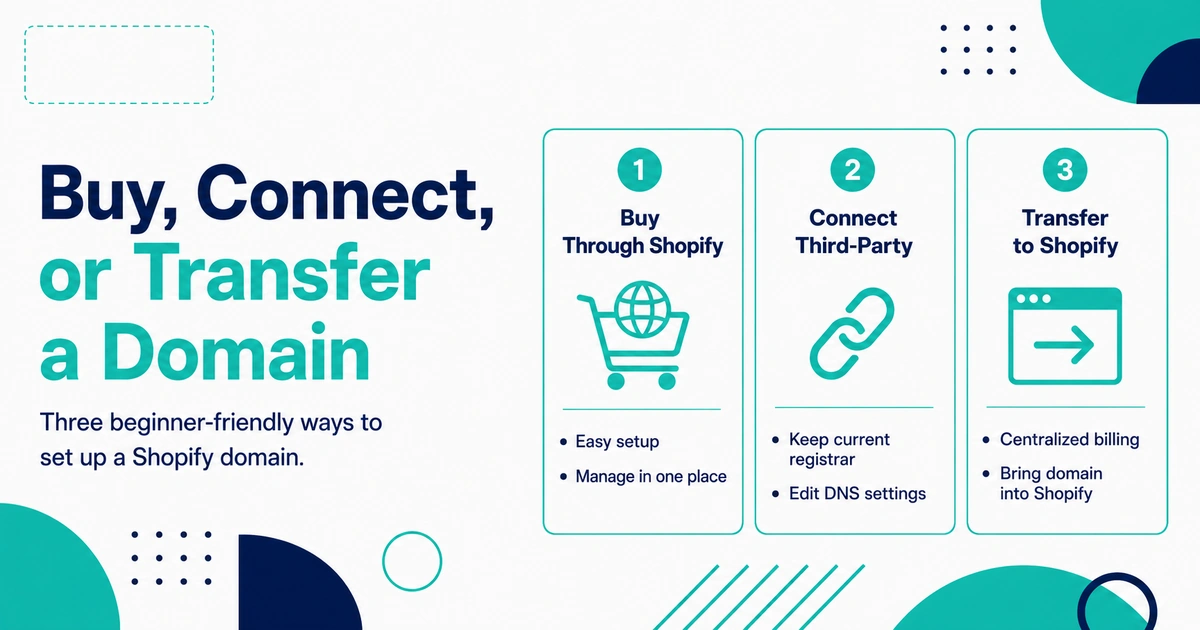
Transferring a domain means moving domain management from your current registrar to Shopify. This can simplify management if you want Shopify to handle domain settings and renewal inside the Shopify admin.
Transferring is different from connecting. Connecting points the domain to Shopify while keeping the registrar elsewhere. Transferring changes where you manage the domain.
Transfer may make sense if:
- You want to manage domain settings in Shopify.
- You want billing and renewal in Shopify.
- Your domain extension is eligible for transfer.
- You do not rely heavily on registrar-specific services.
- You want simpler support for domain settings.
Connecting may be better if:
- You want to keep your current registrar.
- You already use email or DNS services tied to that registrar.
- Your domain extension is not eligible for transfer to Shopify.
- You manage many domains outside Shopify.
- Your registrar has pricing or DNS tools you prefer.
Transfer cost reminder
Shopify’s connect-vs-transfer comparison says transferring a domain to Shopify has a one-year domain renewal fee. This means transfer is not always “free” even if you already own the domain.
Email Hosting and Forwarding Costs
Email is a common domain cost beginners forget.
Shopify says it does not offer email hosting, but you can connect a third-party email hosting service to your custom domain. Shopify also provides email forwarding options for domains bought through Shopify.
Email forwarding vs email hosting
| Email option | What it does | Beginner note |
|---|---|---|
| Email forwarding | Forwards messages from a domain address to another inbox. | Useful for simple receiving, but not the same as full hosted email. |
| Email hosting | Provides full mailbox service for sending and receiving branded email. | Often needed for professional business email. |
| Third-party email provider | A service such as a business email provider connected through DNS records. | Usually adds a separate monthly or annual cost. |
Professional email examples
This email address is being protected from spambots. You need JavaScript enabled to view it. This email address is being protected from spambots. You need JavaScript enabled to view it. This email address is being protected from spambots. You need JavaScript enabled to view it. This email address is being protected from spambots. You need JavaScript enabled to view it.
If you plan to use branded email, include email hosting in your domain budget. The domain itself does not automatically give you a full email inbox.
Subdomains and DNS Costs
Subdomains are prefixes added to your main domain, such as www.example.com, help.example.com, or uk.example.com.
Shopify says subdomains belong to the primary domain and can be set up for free on both Shopify-managed domains and third-party domains when using international domains.
Common Shopify subdomain uses
www.example.comfor the main storehelp.example.comfor support contentblog.example.comfor a separate blog systemuk.example.comfor a regional store experienceca.example.comfor a country-specific version
DNS cost considerations
Creating a subdomain is usually not a separate domain purchase if you own the root domain. However, connecting subdomains to third-party tools, help desks, email services, landing page builders, or international setups can require DNS management and sometimes paid services.
Beginner advice
Most new stores do not need many subdomains. Start with one primary domain and add subdomains only when they support a clear store, support, international, or marketing need.
International Domains
International domains are domains or subdomains used for specific countries or regions. They can help create localized shopping experiences for customers in different markets.
Shopify says international domains are available on the Basic Shopify plan or higher. Shopify also says you cannot create international domains from your store’s myshopify.com domain.
International domains may help if:
- You sell in multiple countries.
- You need country-specific URLs.
- You want customers to see local language or currency.
- You run region-specific marketing.
- You want regional search visibility.
- You manage separate market settings.
International domain cost considerations
- Extra country domains can have registration and renewal costs.
- Regional subdomains may avoid buying separate domains.
- Localization may require translation costs.
- International SEO may require extra setup.
- International shipping, taxes, duties, and returns can add operational cost.
- You may need to submit sitemaps for each domain or subdomain in Google Search Console.
International domains are useful for real international strategy. They are usually unnecessary if you are still validating a first store in one market.
Refunds, Cancellation, and Expiration
Domain purchases require caution because they are not like monthly apps that you can simply test and cancel.
Shopify says domain purchases are non-refundable. It also says that if you do not want a Shopify-managed domain subscription to renew automatically, you can deactivate automatic renewal so the domain expires at the end of the registration period.
Important domain rules to remember
- Domain purchases are generally non-refundable.
- You cannot change the URL chosen during domain purchase.
- Shopify-managed domains are registered for one year and can renew annually.
- Auto-renewal helps prevent accidental expiration.
- If you deactivate auto-renewal, the domain can expire at the end of the registration period.
- If you deactivate your store but want to keep using your domain, you may need to transfer the domain before deactivating.
Before closing or pausing a store
If you plan to close, pause, sell, or move your Shopify store, review your domain first. Decide whether you want to keep the domain, transfer it, park it, redirect it, or let it expire.
Do not let an important domain expire by accident. Domains can carry brand equity, backlinks, direct traffic, email reputation, and customer memory.
How to Choose a Domain Name
A good domain should be easy to remember, easy to type, and aligned with your store’s long-term direction.
Good domain qualities
- Short enough to remember
- Easy to spell
- Easy to pronounce
- Hard to confuse with another brand
- Relevant to your store or brand
- Flexible enough for future products
- Clean in lowercase
- Works in social profiles and email addresses
Be careful with:
- Hyphens
- Hard-to-spell words
- Numbers that can be written multiple ways
- Trademark conflicts
- Names too close to competitors
- Very narrow product names if you may expand
- Unusual extensions that customers may forget
Domain and SEO
Your domain name can support trust and memorability, but it is not a substitute for strong content, product pages, internal links, site structure, backlinks, and user experience. Do not overpay for a keyword domain if the brand and content strategy are weak.
Beginner Domain Cost Examples
These examples are simplified. They explain the logic, not exact domain prices.
Example 1: Buy one domain through Shopify
- You buy
yourstore.comthrough Shopify. - You pay the registration price for the selected extension.
- The domain is registered for one year.
- You renew it annually.
- You manage domain settings in Shopify admin.
- You may still need third-party email hosting for full mailbox service.
Example 2: Connect a domain from Namecheap, GoDaddy, or another registrar
- You already own
yourstore.comoutside Shopify. - You update DNS records to point the domain to Shopify.
- Shopify does not charge an additional domain connection fee.
- You continue paying renewal fees to your third-party registrar.
- You manage DNS, billing, and renewal outside Shopify.
Example 3: Transfer an existing domain to Shopify
- You own a domain at another registrar.
- The extension is eligible for transfer.
- You transfer management to Shopify.
- You pay a one-year domain renewal fee as part of transfer.
- You manage renewal and DNS from Shopify afterward.
Example 4: International domain setup
- You own
example.com. - You create
uk.example.comor buyexample.co.ukfor a region. - Subdomains may avoid extra registration cost, while country domains can require separate registration and renewal.
- You also need to consider language, currency, shipping, duties, taxes, and SEO setup.
Domain Cost Checklist
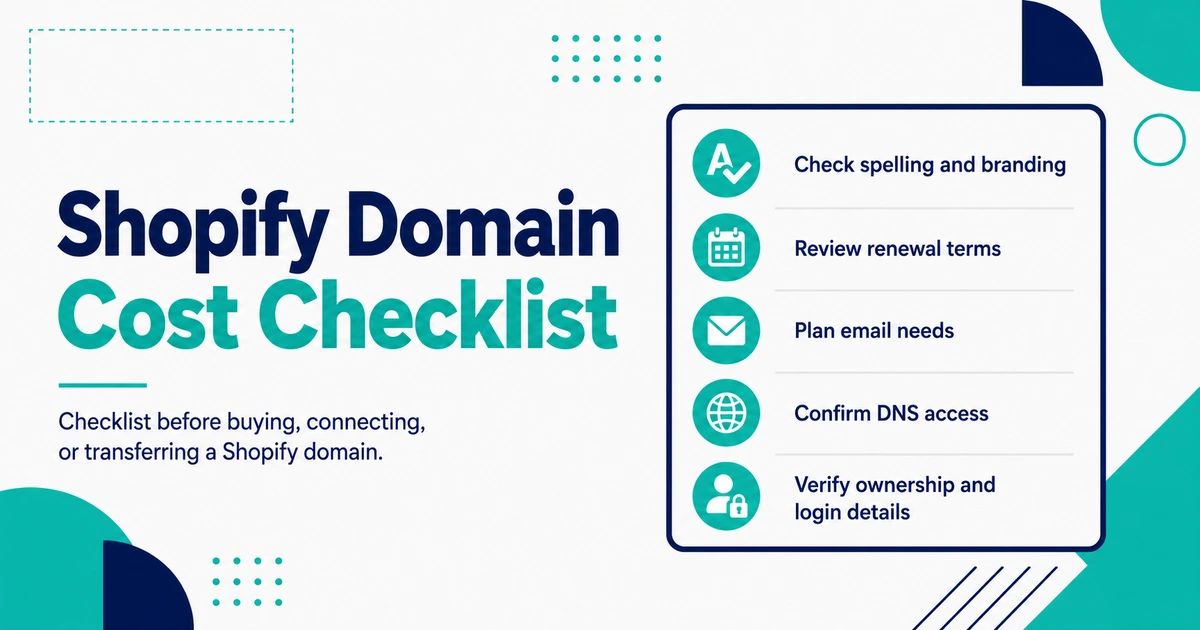
Use this checklist before buying, connecting, or transferring a domain for Shopify.
| Question | Ready? |
|---|---|
| I checked the spelling of the domain carefully. | Yes / No |
| I checked the first-year cost and annual renewal cost. | Yes / No |
| I understand domain purchases are generally non-refundable. | Yes / No |
| I know whether I want to buy through Shopify, connect a third-party domain, or transfer a domain to Shopify. | Yes / No |
| I know where the domain will be renewed each year. | Yes / No |
| I know whether auto-renewal is activated. | Yes / No |
| I checked whether I need professional email hosting. | Yes / No |
| I checked whether I need subdomains or international domains. | Yes / No |
| I checked DNS requirements if connecting a third-party domain. | Yes / No |
| I know what happens to the domain if I close, pause, transfer, or sell the store. | Yes / No |
Common Domain Cost Mistakes
Mistake 1: Thinking the Shopify plan includes a custom domain
Your Shopify plan does not automatically mean you own a custom domain. A domain is usually a separate registration and renewal cost.
Mistake 2: Looking only at first-year price
Renewal price matters. A domain can be cheap in year one and more expensive later.
Mistake 3: Forgetting email hosting
A domain is not the same as a full email inbox. Shopify does not provide email hosting, so professional email may require a third-party service.
Mistake 4: Buying the wrong spelling
Shopify says you cannot change the URL chosen during purchase, and domain purchases are non-refundable. Check carefully before buying.
Mistake 5: Forgetting auto-renewal
Letting a domain expire can damage branding, SEO, ads, email, and customer trust.
Mistake 6: Buying too many defensive domains too early
Some extra domains can protect a brand, but beginners often do not need many variations before the business is validated.
Mistake 7: Confusing connecting with transferring
Connecting keeps your domain at the third-party provider. Transferring moves domain management to Shopify and can involve a renewal fee.
Mistake 8: Planning international domains too early
International domains are useful for real regional strategy. They are usually unnecessary before you validate one primary market.
FAQ
Does Shopify include a free custom domain?
No. Shopify stores have a default myshopify.com URL, but a custom domain usually requires buying or connecting a domain separately.
Can I buy a domain through Shopify?
Yes. You can buy a domain through Shopify and manage many domain settings from the Domains section of Shopify admin.
Are Shopify domain purchases refundable?
No. Shopify says domain purchases are non-refundable, and after you buy a domain you can’t change the URL you chose during purchase.
How long is a Shopify domain registered for?
Shopify says domains purchased through Shopify are registered for one year and can be renewed annually.
Do Shopify domains renew automatically?
You can choose whether to activate automatic renewal when you buy a domain through Shopify or later in Shopify admin. Auto-renewal helps prevent accidental expiration.
Can I connect a domain I bought elsewhere?
Yes. You can connect a third-party domain by updating DNS records at your domain provider. You still manage billing, renewal, and DNS at that provider.
Does Shopify charge to connect a third-party domain?
Shopify’s connect-vs-transfer comparison lists connecting a third-party domain as having no additional cost from Shopify. You still pay your third-party registrar for domain registration and renewal.
What is the difference between connecting and transferring a domain?
Connecting points a third-party domain to Shopify while keeping the registrar elsewhere. Transferring moves domain management to Shopify and can involve a one-year domain renewal fee.
Does Shopify provide email hosting?
No. Shopify says it does not offer email hosting, but you can connect a third-party email hosting service to your custom domain.
Do I need international domains?
Most beginners do not need them at first. International domains are useful when you sell to multiple countries or regions and need localized URLs, languages, currencies, or regional search visibility.
Final Thoughts
A custom domain is one of the most important small investments in a Shopify store, but it should be managed carefully.
Buying through Shopify is often easiest for beginners because setup and renewal can be managed from Shopify admin. Connecting a third-party domain can be better if you already own a domain, prefer your current registrar, or use existing DNS and email services. Transferring to Shopify can simplify management, but it is different from connecting and can involve a renewal fee.
Before choosing, check first-year cost, renewal cost, refund rules, auto-renewal, email hosting, DNS management, subdomains, international plans, and what happens if you close or move the store.
The best domain setup is not just the cheapest. It is the one you can manage reliably, renew safely, and use confidently as your store grows.
Next recommended guide: Shopify Domain Setup