Shopify Advanced Plan Explained for Beginners
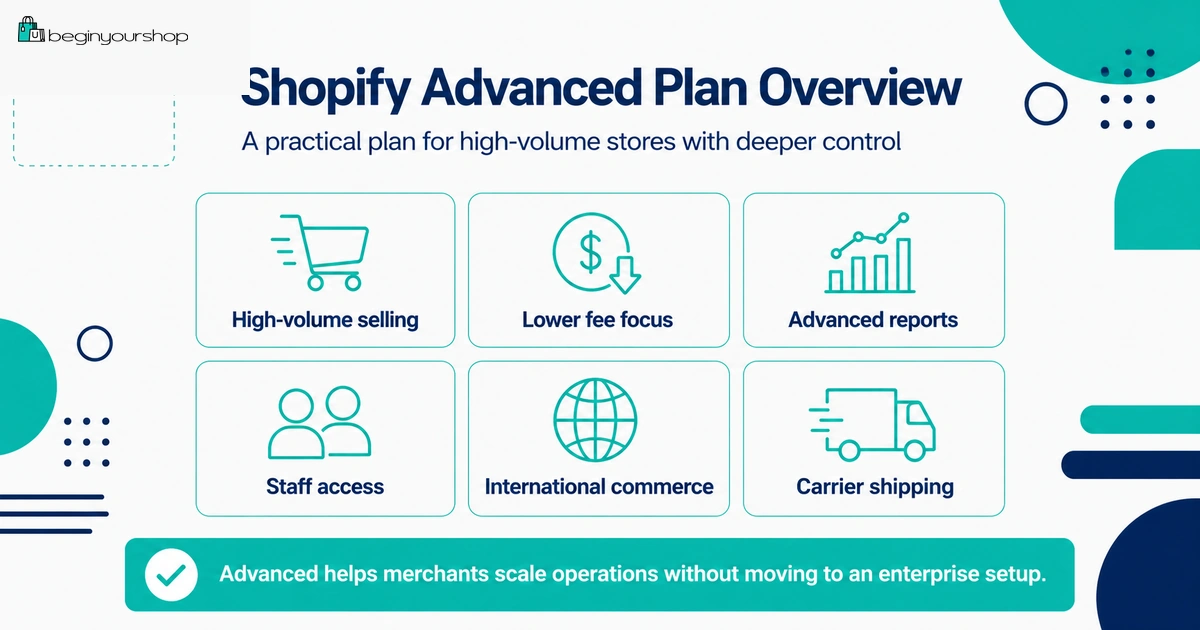
The Shopify Advanced plan is usually not the first plan beginners need. It is designed for higher-volume stores, businesses migrating from another platform, and merchants that need stronger reporting, more staff access, carrier-calculated shipping, international commerce tools, and the lowest credit card rates and transaction fees in Shopify’s standard plan lineup.
This beginner-friendly article explains the Shopify Advanced plan, who it is best for, what it adds beyond Basic and Grow, when upgrading can make sense, when it is too early, and what costs to review before choosing Advanced.
The Shopify Advanced plan can be powerful, but it is also easy for beginners to misunderstand.
Some new store owners assume that choosing a higher plan makes the store more professional, more trustworthy, or more likely to get sales. That is not how it works. Customers do not buy because your admin uses a higher Shopify plan. They buy because your products, pricing, store experience, checkout, shipping, trust signals, and marketing make sense.
Advanced is usually a plan for stores that have already moved beyond the earliest stage. It can be valuable when you need more comprehensive reports, more staff accounts, carrier-calculated shipping, international commerce tools, and better plan economics because your order volume is high enough.
For most beginners, Basic or Grow will be more relevant at the start. Advanced becomes worth comparing when the store has real volume, more complex operations, or a migration use case that requires stronger features from the beginning.
This guide explains the Advanced plan from a practical beginner perspective so you can avoid overpaying too early and also recognize when Advanced is genuinely useful.
Last checked: July 24, 2026. Shopify plan names, pricing, card rates, transaction fees, staff limits, reports, markets, carrier-calculated shipping, and international commerce features can change. Always review Shopify’s official pricing page and Shopify Help Center before choosing or changing a plan.

Quick Answer
The Shopify Advanced plan is best for high-volume businesses, stores migrating from another ecommerce platform, and merchants that need the lowest transaction fees, more comprehensive reports, custom reports, carrier-calculated shipping, international commerce tools, more staff accounts, and stronger operational control. Most beginners should not start with Advanced unless they already have a clear high-volume, migration, shipping, reporting, or international selling reason.
Best for
High-volume stores, migration projects, advanced reporting needs, complex shipping, and international growth.
Usually too early for
New stores with no sales, no traffic, incomplete product pages, or no proven customer acquisition channel.
Upgrade rule
Choose Advanced when the extra features or fee savings clearly justify the higher monthly cost.
What Is the Shopify Advanced Plan?
The Shopify Advanced plan is a paid Shopify plan designed for stores with more serious growth, reporting, shipping, international, and operational needs.
Shopify describes Advanced as best for high-volume businesses that need the lowest transaction fees, or businesses migrating from another platform. Shopify also says Advanced includes enhanced features for retail stores.
Advanced plan in plain language
Advanced is a plan for stores that need more than basic launch tools. It is for merchants that need better operational visibility, more sophisticated reports, more staff access, stronger shipping rate options, lower fees, and more control over international selling.
Advanced can be relevant when your business needs:
- Lowest credit card rates and transaction fees in the standard Shopify plan lineup
- More staff user accounts
- Carrier-calculated shipping
- More comprehensive reports
- Custom reports
- Predicted values in certain reports
- International sales tools
- Duties and import tax calculation and collection
- Market pricing controls
- Enhanced support
For a brand-new store with no traffic or sales, these features are often premature. For a high-volume store or migration project, they can be important.
Who Is Advanced Best For?
Advanced is best for stores that already have enough complexity or volume to need stronger tools.
Advanced may be a good fit if:
- You already have high sales volume.
- You are migrating an established store from another platform.
- You need the lowest available transaction fees in Shopify’s standard plans.
- You need 15 user accounts for team access.
- You need carrier-calculated shipping from third-party shipping services.
- You need custom reports or more comprehensive reporting.
- You sell internationally and need duties, import taxes, market pricing, or region-specific settings.
- You have operations that are becoming too complex for Basic or Grow.
- You have enough sales data to benefit from more advanced analytics.
Advanced may not be right yet if:
- You have not launched your store.
- You do not have consistent sales.
- You are working alone and do not need staff accounts.
- You do not need custom reports.
- Your shipping model is simple.
- You do not sell internationally yet.
- You are choosing Advanced only because it feels more serious.
- You have not calculated whether fee savings offset the higher plan cost.
Advanced is not a credibility badge. It is an operations and scaling plan.
What Advanced Adds Beyond Basic and Grow
Shopify says the Advanced plan contains all features of Basic and Grow, and adds the lowest credit card rates and transaction fees. It also includes features that are more useful for larger or more complex businesses.
| Feature area | What Advanced adds | Why it matters |
|---|---|---|
| Fees | Lowest credit card rates and transaction fees among Shopify’s standard plans. | Can improve margins when order volume is high enough. |
| Staff | Supports 15 user accounts. | Useful for teams handling operations, fulfillment, support, marketing, and management. |
| Shipping | Includes carrier-calculated shipping. | Useful when customers need up-to-date rates from third-party shipping services. |
| Reports | More comprehensive reports, custom reports, and predicted values for certain reports. | Useful for planning, forecasting, and analyzing performance. |
| International commerce | Tools for duties, import taxes, price percentage adjustments, and product prices by country or region. | Supports more complex cross-border selling. |
| Markets | Includes 3 markets, with an option to increase to more markets for an additional cost. | Useful for managing region-specific international selling. |
| Support | Enhanced 24/7 chat support. | More useful when the store has higher operational stakes. |
Lowest Credit Card Rates and Transaction Fees
One of the biggest reasons to consider Advanced is fee economics. Shopify’s pricing and billing overview explains that Basic, Grow, and Advanced plans have multiple rates and fees, including monthly price, credit card rates, and third-party transaction fees.
Shopify’s Advanced plan documentation says Advanced has the lowest credit card rates and transaction fees. Shopify’s choosing-a-plan guidance also notes that on higher-tier plans, credit card fees are lower, and the exact point where upgrading saves money depends on your location and whether you use Shopify Payments.
Two fee types to understand
| Fee type | What it means | Why it matters for Advanced |
|---|---|---|
| Payment processing fee | The fee for processing customer card or digital payments. | Lower rates can matter significantly when order volume is high. |
| Third-party transaction fee | A Shopify fee that can apply when using external payment providers. | Lower transaction fees can matter if you rely on third-party providers. |
How to evaluate fee savings
Do not choose Advanced only because it has better rates. Do the math:
- Estimate your monthly order volume.
- Estimate your monthly revenue.
- Compare payment processing costs by plan.
- Compare third-party transaction fees if relevant.
- Subtract the higher monthly subscription cost.
- Include the value of other Advanced features you will actually use.
If fee savings plus feature value clearly exceed the extra cost, Advanced may make sense. If not, Grow or Basic may be more efficient.
Staff Accounts
Advanced supports 15 user accounts. This is useful when a store has a real team, not just one owner managing everything.
Staff roles that may need Shopify access
- Store owner
- Operations manager
- Fulfillment team member
- Customer support agent
- Marketing manager
- Content editor
- Inventory manager
- Finance or reporting role
- Developer or agency partner
- Retail store staff if relevant
When staff accounts justify Advanced
Staff accounts become important when you need different people to work inside Shopify without sharing credentials. They are also important when you need better permission control and operational accountability.
Advanced may be overkill if you are still working alone. It becomes more relevant when team access is a real operational requirement.
Carrier-Calculated Shipping
Carrier-calculated shipping is one of the clearest feature-based reasons to choose Advanced. Shopify’s Advanced plan documentation says carrier-calculated shipping lets you integrate with a third-party shipping service to provide customers with up-to-date shipping rates and options when they place an order.
Shopify’s third-party carrier-calculated shipping documentation states that this feature is available on Shopify Advanced and Shopify Plus plans. It also notes that Shopify Grow stores can add it for an additional monthly fee or by switching to annual billing.
Carrier-calculated shipping may matter if:
- You ship products with variable weights or dimensions.
- You use third-party carrier accounts.
- You sell products that require accurate real-time shipping rates.
- You ship to many regions.
- You sell internationally.
- Flat-rate shipping would be too inaccurate or unprofitable.
- Customers expect to choose among multiple shipping options.
Carrier-calculated shipping may not matter if:
- You use simple flat-rate shipping.
- You offer free shipping built into product pricing.
- Your products are lightweight and predictable.
- You ship only to one region with simple rates.
- Your store is still validating demand.
Do not choose Advanced only for shipping unless carrier-calculated rates are genuinely important to your checkout experience and margins.
Advanced Reports and Custom Reports
Advanced offers the most comprehensive reports in Shopify’s standard plan lineup. Shopify says Advanced lets you create custom reports and activate predicted values in certain reports.
Advanced reports can help with:
- Sales performance analysis
- Customer behavior analysis
- Product performance tracking
- Inventory decision-making
- Marketing performance review
- Forecasting and planning
- Regional performance analysis
- Operational reporting
When advanced reports are worth it
Advanced reporting is useful when your store has enough data to make reporting meaningful. If your store has little traffic and few sales, advanced reports will not create insight by themselves.
Reporting value increases when:
- You have consistent sales.
- You run multiple campaigns.
- You manage more inventory.
- You sell across regions.
- You need forecasting.
- You need custom views for decision-making.
For a brand-new store, product clarity and traffic usually matter more than advanced reporting. For a growing store, reporting can become a major advantage.
International Commerce and Markets
Advanced can be useful for international ecommerce. Shopify says Advanced supports international growth through international sales tools that let you configure settings for each international region.
Shopify’s Advanced plan documentation says that through Advanced, you can calculate and collect duties and import taxes, control prices in different markets using price percentage adjustments, and set product prices by country or region. It also says Advanced includes 3 markets, with the option to increase to more markets at an additional cost.
International commerce features may matter if:
- You sell across multiple countries or regions.
- You need duties and import taxes handled more clearly.
- You need region-specific pricing.
- You need market-specific settings.
- You need more control over cross-border customer experience.
- You are expanding from domestic selling to international selling.
International commerce may be premature if:
- You have not launched domestically.
- You do not understand your shipping costs yet.
- You have no international traffic.
- You have not reviewed tax and duties implications.
- You are still testing product demand.
International selling can increase opportunity, but it also increases complexity. Use Advanced when that complexity is real and near-term.
Shopify Advanced vs Grow
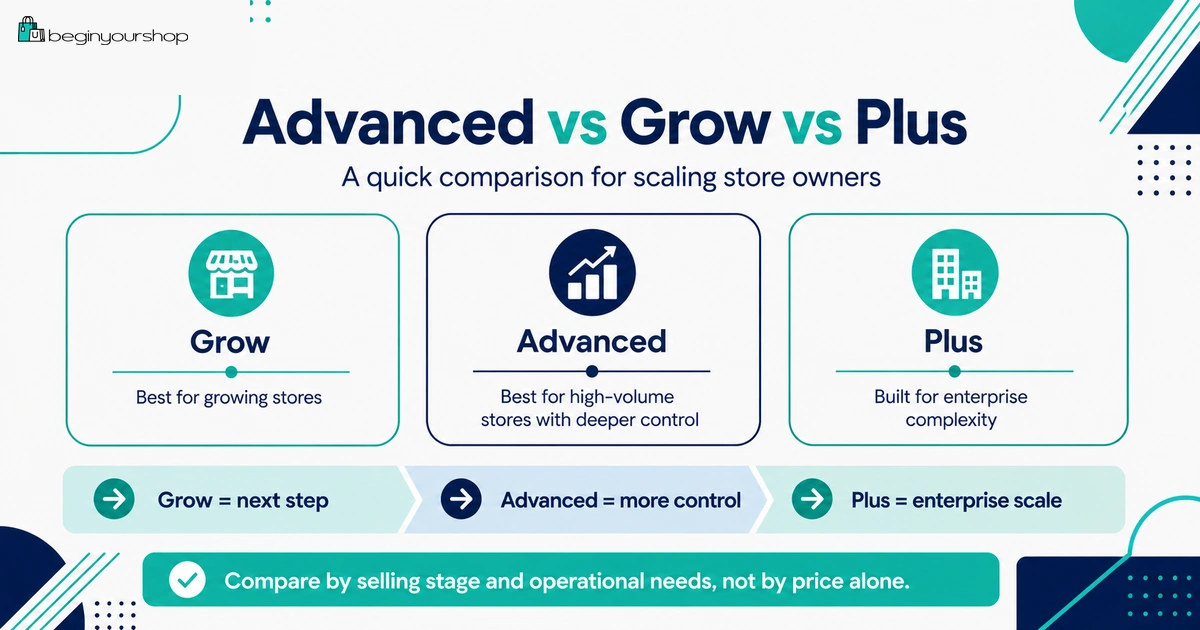
Grow is designed for growing businesses with consistent sales that need more features than Basic. Advanced is designed for high-volume businesses, businesses migrating from another platform, and stores that need stronger advanced features.
| Question | Grow | Advanced |
|---|---|---|
| Best for | Growing businesses with consistent sales that need more features than Basic. | High-volume businesses, migration projects, and stores needing the lowest fees or advanced operations. |
| Staff | Supports fewer staff accounts than Advanced. | Supports 15 user accounts. |
| Reports | Stronger reports than Basic. | Most comprehensive reports, custom reports, and predicted values in certain reports. |
| Shipping | Carrier-calculated shipping may require an add-on or annual billing. | Carrier-calculated shipping is included. |
| Fees | More competitive than Basic. | Lowest credit card rates and transaction fees among standard plans. |
| International commerce | Supports international growth tools. | More advanced controls for duties, import taxes, and market pricing. |
Choose Grow if:
- You need more than Basic but are not high-volume yet.
- You need some staff access and stronger reports.
- You do not need carrier-calculated shipping included.
- You do not need Advanced-level international controls.
- The cost difference to Advanced is not justified.
Choose Advanced if:
- You are high-volume.
- You need lowest fees in standard Shopify plans.
- You need 15 user accounts.
- You need carrier-calculated shipping included.
- You need custom reports.
- You need more advanced international commerce features.
- You are migrating an established store from another platform.
Shopify Advanced vs Shopify Plus
Advanced is still part of Shopify’s standard plan lineup. Shopify Plus is designed for more complex, high-volume businesses with more advanced platform needs.
Shopify’s Plus documentation says Plus offers features to help further grow high-volume businesses and can involve platform fees based on revenue and business model for more complex, higher-volume businesses.
Advanced may be enough if:
- You need strong standard-plan features.
- You need advanced reports and carrier-calculated shipping.
- You need 15 user accounts.
- You need international tools but not enterprise-level platform customization.
- Your business is high-volume but not yet Plus-level complex.
Shopify Plus may be worth exploring if:
- You have enterprise-level volume or complexity.
- You need specialized Plus apps or channels.
- You need more advanced automation, B2B, wholesale, or platform control.
- You need a negotiated or enterprise-level setup.
- Your business model requires a Plus-level solution.
Most beginners do not need Plus. Many growing stores do not need Plus either. Compare Plus only when Advanced is no longer enough.
Costs Beyond the Advanced Plan
The Advanced subscription is not your only cost. A higher plan can reduce some fees or unlock features, but your total store cost may still include many other expenses.
Costs to include in your budget
- Shopify Advanced subscription
- Payment processing fees
- Third-party transaction fees if using external payment providers
- Paid apps
- Paid theme or custom development
- Domain name
- Product samples
- Inventory
- Packaging and shipping supplies
- Third-party shipping services
- Email marketing tools
- Advertising
- Content production
- Accounting, tax, legal, and admin costs
Advanced does not fix weak fundamentals
Advanced will not fix:
- Bad product-market fit
- Weak product pages
- Poor product photography
- Unclear pricing
- Missing trust signals
- No traffic plan
- Unprofitable shipping
- Poor mobile experience
Do not upgrade to Advanced until the store fundamentals are already working or the migration use case clearly requires it.
When to Upgrade to Advanced
Advanced is worth considering when the store has real volume or feature requirements that justify the higher cost.
Upgrade to Advanced when:
- Your sales volume makes lower fees financially meaningful.
- You need carrier-calculated shipping included in the plan.
- You need 15 user accounts.
- You need custom reports or more comprehensive reporting.
- You need duties and import tax tools for international selling.
- You need market-specific price controls.
- You are migrating an established ecommerce business.
- Your operations are clearly beyond what Grow can comfortably support.
Simple Advanced upgrade test
Advanced is worth reviewing when the plan either saves enough money through fees, unlocks required operations, or provides reporting and international tools that your store actively needs.
If the benefit is vague, wait. If the benefit is measurable or operationally necessary, compare Advanced carefully.
When Not to Choose Advanced Yet
Advanced can be a poor choice if the store is still in early testing mode.
Do not choose Advanced yet if:
- You have not launched.
- You have no sales volume.
- You are still validating product demand.
- You do not need 15 user accounts.
- Your shipping setup is simple.
- You do not need custom reports.
- You are not selling internationally.
- You have no traffic plan.
- You are choosing it only because higher sounds better.
In these cases, Basic or Grow is usually a better starting point, or you may need to improve store readiness before choosing any higher plan.
Shopify Advanced Plan Decision Checklist
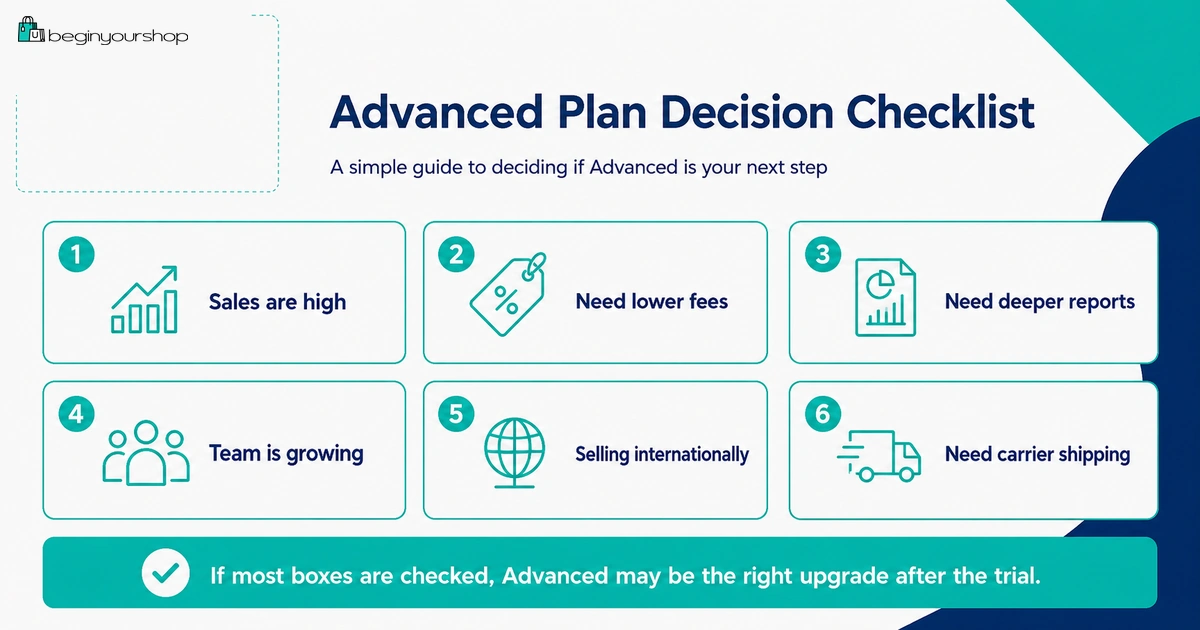
Use this checklist before choosing or upgrading to Advanced.
| Question | Ready? |
|---|---|
| My store has high sales volume or I am migrating an established store. | Yes / No |
| I have calculated whether lower fees offset the higher monthly cost. | Yes / No |
| I need 15 user accounts or more team access than Grow provides. | Yes / No |
| I need carrier-calculated shipping included in the plan. | Yes / No |
| I need custom reports or more comprehensive reporting. | Yes / No |
| I need international commerce tools such as duties, import taxes, or market pricing controls. | Yes / No |
| I understand all additional costs beyond the subscription price. | Yes / No |
| I know why Advanced is better than Grow for my current store. | Yes / No |
| I know whether Shopify Plus is unnecessary or should be evaluated separately. | Yes / No |
| My product pages, checkout, shipping, policies, and traffic strategy are already working. | Yes / No |
If most answers are “yes,” Advanced may be worth serious comparison. If most answers are “no,” it is probably too early.
Common Advanced Plan Mistakes
Mistake 1: Choosing Advanced before having sales
Advanced is usually for high-volume or more complex businesses. If you have no sales data, you likely cannot know whether the plan economics make sense.
Mistake 2: Assuming higher plan means more sales
A higher plan does not create product demand. Marketing, product quality, trust, pricing, and customer experience still matter more.
Mistake 3: Ignoring the upgrade math
Lower fees only matter if your volume is high enough. Always compare fee savings against the higher subscription cost.
Mistake 4: Paying for reports before having data
Advanced reports are useful when there is enough traffic and sales activity to analyze.
Mistake 5: Not using included features
If you do not use carrier-calculated shipping, custom reports, staff accounts, or international tools, Advanced may not be worth the extra cost.
Mistake 6: Confusing Advanced with Plus
Advanced is a strong standard plan. Plus is for more complex, higher-volume businesses with different requirements.
FAQ
What is the Shopify Advanced plan?
The Shopify Advanced plan is a paid Shopify plan for high-volume businesses, businesses migrating from another platform, and stores that need lower fees, more staff accounts, carrier-calculated shipping, advanced reports, custom reports, and international commerce tools.
Who should use Shopify Advanced?
Advanced is best for high-volume stores, migration projects, and businesses that need features beyond Grow, such as carrier-calculated shipping, 15 user accounts, more comprehensive reports, and stronger international commerce tools.
Is Shopify Advanced good for beginners?
Usually no. Most beginners do not need Advanced unless they are migrating an established business, already have high sales volume, or have specific shipping, reporting, staff, or international needs.
What does Advanced include beyond Grow?
Advanced includes all Basic and Grow features, plus the lowest credit card rates and transaction fees, 15 user accounts, carrier-calculated shipping, more comprehensive reports, custom reports, predicted values in certain reports, advanced international commerce tools, markets, and enhanced support.
Does Shopify Advanced include carrier-calculated shipping?
Yes. Shopify’s Advanced plan documentation says carrier-calculated shipping is included, and Shopify’s carrier-calculated shipping documentation says this feature is available on Advanced and Plus plans.
How many user accounts does Shopify Advanced support?
Shopify’s Advanced plan documentation says Advanced supports 15 user accounts.
Does Shopify Advanced have lower fees?
Shopify describes Advanced as having the lowest credit card rates and transaction fees among Basic, Grow, and Advanced. Exact rates depend on region, payment setup, and current Shopify pricing.
Should I choose Advanced or Grow?
Choose Grow if you need more than Basic but do not yet need Advanced features. Choose Advanced if you need the lowest fees, 15 user accounts, included carrier-calculated shipping, custom reports, or stronger international tools.
Should I choose Advanced or Shopify Plus?
Advanced may be enough for many high-volume stores that need strong standard-plan features. Shopify Plus is for more complex, higher-volume businesses with enterprise-level needs. Contact Shopify if you are evaluating Plus.
When should I upgrade to Advanced?
Upgrade when high sales volume, carrier-calculated shipping, custom reports, staff needs, international commerce tools, or migration requirements clearly justify the higher monthly cost.
Final Thoughts
The Shopify Advanced plan can be valuable, but it is not usually the right first plan for a beginner store.
Advanced is best for high-volume businesses, migration projects, and stores that need lower fees, carrier-calculated shipping, more staff access, custom reporting, and stronger international commerce tools. Those features matter when the business has enough volume or complexity to use them.
If you are just starting, focus first on products, store clarity, checkout, shipping, policies, mobile experience, and traffic. Choose Advanced when your store has the operational need and the numbers justify the upgrade.
Next recommended guide: Shopify Pricing Explained